
Non-Alcoholic Suggestions That Start with Showing the Bottle—Why Maison Paul Bocuse Serves Them on a Cart


In the world of French cuisine, the name Paul Bocuse carries a special resonance. “Restaurant Paul Bocuse” in Lyon, France, is a global mecca for fine dining and holds a special place in the hearts of not only chefs but also service staff. Consequently, the expectations of guests who walk through its doors are high. Maison Paul Bocuse in Daikanyama continues to meet those expectations day after day.
In the dining room at Maison Paul Bocuse, alongside the champagne for the toast, a cart laden with bottles of non-alcoholic beverages is wheeled in. This scene was designed by Yusuke Okabe, who, as the sommelier, oversees everything from wine management to service operations.
What became clear in this interview is that Mr. Okabe’s approach to non-alcoholic offerings is designed not simply to “place” them but to “showcase” them. As the cart makes its rounds, it catches the guests’ eyes, and a conversation begins with the simple question, “What’s that?” The result is an experience where those who drink and those who don’t can enjoy themselves equally at the same table.
From Hospitality to Wine—The Foundation Laid at Auberge de Lille Tokyo
Mr. Okabe’s career began as a server at Auberge de Lille Tokyo, where he was assigned after joining the company as a new graduate. Over the course of about six years, working under the head sommelier at the time, he gradually increased his exposure to wine while honing his skills as a sommelier.
However, he didn’t deal exclusively with wine. He handled every aspect of service, including “découpage”—the art of carving dishes in front of guests.
“You have to do it all. You can’t just stick to wine.”
This experience of working on the front lines without separating beverages from service forms the foundation for the approach of “pairing dishes based on color and flavor”—which will be discussed later—as well as for the art of “presentation.”
Currently, he is responsible for wine management and service, as well as a portion of the restaurant’s operations. His daily focus is on ensuring that guests enjoy themselves. And there is one more thing.
“It’s about properly upholding the Paul Bocuse brand. Ever since I started here, I’ve been told time and again that I must protect the brand.”
We meet the expectations placed on the Paul Bocuse brand through our daily morning coordination meetings.
Guests come specifically for the name “Maison Paul Bocuse.” The location in Daikanyama further reinforces this character. It’s not a place to drop in casually; rather, it’s a destination where guests make reservations, dress up, and visit with a specific purpose in mind—and the clientele consists primarily of adults.
We also welcome several groups of international guests each week, mainly from Asia. While they account for only a few percent of our total guests, their reactions are strong, and their standards are high.
“If they like it, they’ll say, ‘This is really great,’ but if we don’t meet their expectations, they’ll ask, ‘Why is it like this here? This is Paul Bocuse, isn’t it?’ They look at the big picture.”

The mechanism designed to meet those expectations is the daily morning meeting. During the meeting, the staff reviews reservations and requests, and coordinates with each team to determine how to serve each guest and present the dishes. On birthdays, they play a rare antique music box—a tradition carried over from the flagship restaurant in Lyon—at the guests’ table. This is a unique touch exclusive to this restaurant, designed to allow guests in Japan to experience that same atmosphere.
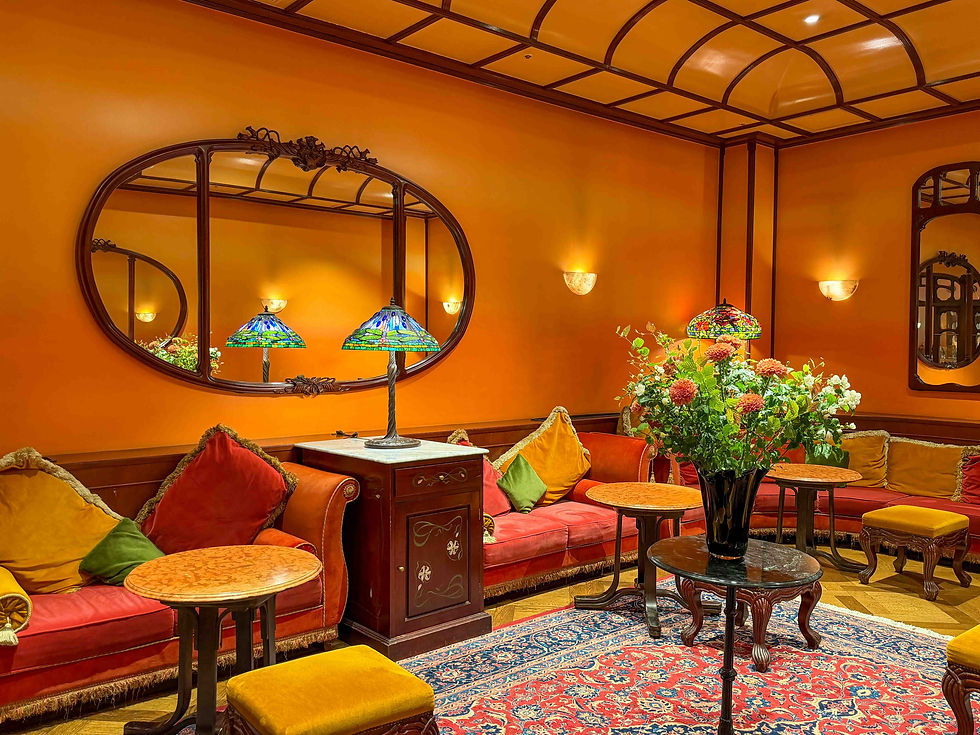
In September 2025, the restaurant reopened following a major renovation. With “Echo Nouveau” (New Resonance) as the interior design concept, the space has been transformed into an environment that blends modern materials and designs while preserving the beauty of its Art Nouveau architecture.
“In the entrance and waiting areas, we’ve essentially retained the Art Nouveau design elements from the previous restaurant. Guests enter this space to meet up before proceeding to the dining room. We hope they’ll fully enjoy the cuisine, service, and the restaurant’s unique atmosphere while experiencing the elegance and history of our Lyon flagship restaurant in this newly revitalized space.”
Guests are greeted by classic design elements as they proceed to the dining room, which has been revitalized through the renovation.

The turning point came with the COVID-19 pandemic. Communicating through science, reading the room, and “showing”
Mr. Okabe began taking non-alcoholic beverages seriously during the COVID-19 pandemic, while he was still working at his previous restaurant. Since they couldn’t serve alcohol, he had to figure out what to do. He started with non-alcoholic wine and gradually expanded the menu to include tea and juice.
What Mr. Okabe honed during this time was the art of making well-reasoned recommendations. For example, he would pair green tea—which is rich in the amino acid theanine—with ingredients high in glutamic acid. By highlighting their scientific compatibility, he’d say, “These two go really well together—why don’t you give it a try?”
On the other hand, sometimes his suggestions don’t resonate. Quite a few customers have the habit of drinking only water during meals. Without being pushy, he wanted them to at least be aware that other options existed. The solution was to “show” them.
“I line up all the recommended drinks on a cart and introduce them to each table. That catches their eye—they notice, ‘Something’s going on over there.’ When they ask, ‘What’s that?’, I can say, ‘It’s this—would you like to try it?’”
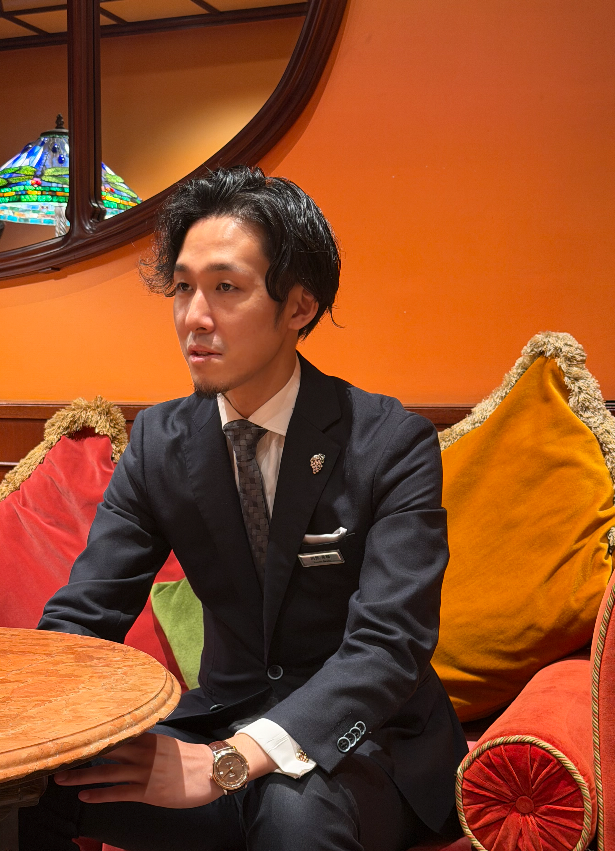
Even after transferring to Maison Paul Bocuse, he continued to make this cart service the cornerstone of his approach. For the first round of drinks, he presents a selection of champagnes arranged on the cart while simultaneously pointing out, “We also have a variety of non-alcoholic beverages.” Over the course of about a year after taking the position, he revamped the non-alcoholic beverage list as well. True to Mr. Okabe’s background as a former flair bartender who honed his performance skills, this design is rooted in the concept of “showmanship.”
This commitment to “showmanship” is seamlessly integrated with the food service as well. The découpage performed right in front of guests, much like the service cart, draws their gaze by making them think, “Something’s happening over there.” And this effect is further enhanced by the seating arrangement, which was changed during the renovation.
“With découpage, guests’ eyes are inevitably drawn to the action—they wonder, ‘What are they doing?’ During the renovation, we paid close attention to the placement of tables and seats, arranging them so that every guest can see the servers in action.”
Previously, guests sat facing each other, so they had to turn their heads to look around the restaurant. After the renovation, the tables were arranged in a “V” shape to allow guests’ eyes to naturally fall on the action. When they catch a glimpse, it leads to thoughts like, “Maybe I’ll try that next time,” which fosters repeat business. The drinks are also positioned right where their gaze lands.
An equal glass for the seat where only water was placed
Mr. Okabe describes the value of non-alcoholic pairings using the word “equality.”
“People who don’t drink can enjoy the experience on an equal footing with those drinking wine. Even at business dinners, the host can place an order saying, ‘Please serve non-alcoholic pairings for our guests. For us, the usual selection is fine.’”
In the past, non-drinkers would have nothing but a bottle of water in front of them. No matter how good the water is, when wine glasses are being passed around right next to you, a disparity in the experience inevitably arises. Non-alcoholic pairings bridge that gap.
In fact, he says an increasing number of customers are now specifying non-alcoholic pairings at the time of reservation. In the past, while the person sitting across from you was chatting with the sommelier and selecting a glass, you had no choice but to keep drinking the same thing. The significance of being able to say, “I can enjoy the pairing too,” is immense.
When making recommendations, I’m also conscious of maintaining an equal footing. Instead of spouting trivia, I replace it with words that align with the guest’s preferences.
“If we use fruit as an analogy, do you prefer something like a pear, a lychee, or perhaps a grapefruit? Then I’ll say, ‘In that case, how about this one?’—I think that’s an easy way to explain it.”
The selection criteria are “flavor” and “color.”
So, what criteria does he use when selecting non-alcoholic beverages? Mr. Okabe’s answer is clear: while price is naturally a factor, his main considerations are “flavor” and “color.”
The “color” criterion is interesting. Mr. Okabe also pairs dishes and drinks based on color. For shrimp dishes, he chooses a pinkish hue. And,
“Rosé wine and jasmine or rooibos tea are almost the same color. It creates an atmosphere where guests feel they’re drinking the same thing, and we can serve them in the same glass.”
On the table, the glasses for those drinking alcohol and those who aren’t look identical. Color is an element that visually reinforces the “equality” mentioned earlier.
The criterion for flavor is that it shouldn’t be tiring to drink. Unlike alcohol, non-alcoholic beverages don’t evaporate, so they tend to sit heavier in the stomach. If they’re too strong or too sweet, guests tend to stop drinking partway through. That’s why he chooses simple, easy-to-understand flavors.
“I don’t want to make our guests think too much. The meal is the main focus.”
The serving process is designed with the same precision as wine service. The serving size is about 100 cc when served on its own, and 50–70 cc when paired with food. For a toast, we use a champagne glass; for enjoying the aroma during the meal, we use a rounded glass. The temperature shouldn’t be too cold, but if it’s too warm, the sweetness comes out too strongly.
The Next Step Beyond “Familiarity”: A Journey That Began with a Tasting Event at Ristorante ASO
My first encounter with Apoptosis was at a tasting event held at Ristorante ASO, located across the street. Although Maison Paul Bocuse already carried a well-established bottled tea at the time, they were looking for new options.
“The non-alcoholic drinks we’d had up until then were great, but our customers had become too accustomed to them. They start wondering, ‘Is there anything new?’ and want to try something different.”
After a series of tastings, the selection fell on Apoptosis’s sparkling tea and “Non-Alchemist,” a wine alternative drink curated by Apoptosis. The guidelines for serving them are simple: Apoptosis’s sparkling tea is served as an aperitif or for toasts, while still bottled teas and Non-Alchemist are served with meals. Among these, the rooibos sparkling tea had a specific purpose in mind.
“Rooibos tea isn’t widely available. Plus, since it’s caffeine-free and sparkling, we thought it would be perfect for the first drink.”
The target audience was pregnant guests and groups of young women. In fact, this suggestion has been well-received. Currently, since the first course features a tomato-based dish, they also recommend pairing the rooibos tea with the dish to complement the tomato’s color.
The smoked black tea sparkling tea, with its smoky yet refreshing flavor derived from cherry wood chips, pairs well with finger foods, cheese, and charcoal-grilled dishes. What was particularly striking was that this pairing originated from the customers themselves. They received feedback saying, “It was absolutely delicious,” when it was served with finger foods featuring yellow beet mousse and Parmesan cheese sablés.
“I’d never tried that combination before. It really made me think, ‘Ah, I see.’”
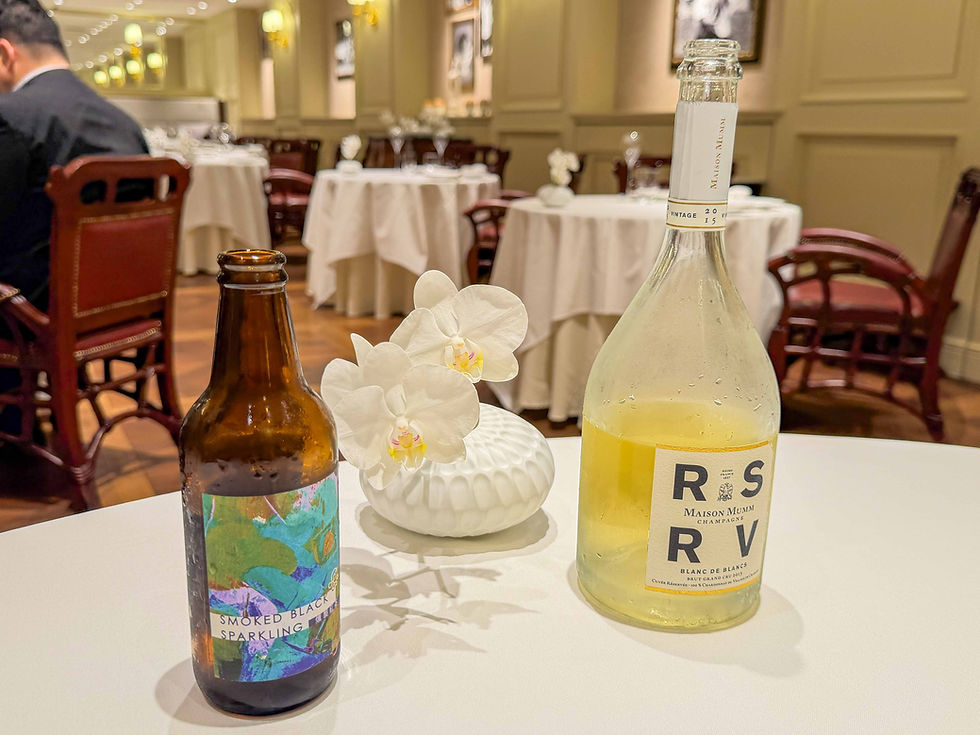
Mr. Okabe serves these sparkling teas while asking customers about their preferences.
“The smoked black tea has the strongest aroma, so if you’d like something a little smoky and refreshing, I’d recommend this one. If you prefer something refreshing like hibiscus or lemongrass, try the rooibos. And if you’d prefer a simpler, non-alcoholic sparkling drink, I have that available as well,” he says.
Non-Alchemist is a series of drinks that recreate the flavors of wine without using alcohol. “Tirolipeka,” infused with white truffle, piques guests’ curiosity with the simple description: “a liquid containing truffles.” “Van Cleef,” made with cacao husks and tonka beans, evokes the flavor of cacao without being sweet and has a long finish. It is sometimes served in a liqueur glass after a meal. There’s also “Marika,” with its distinct jasmine aroma, and each drink’s unique character is utilized throughout the meal, from the meal itself to the after-dinner period.
When asked about a particularly memorable customer reaction, Mr. Okabe cited not only the strong appeal of the truffles but also a specific comment.
“Someone once told me, ‘I like tonka beans, so I’d prefer one that contains them.’ I wondered if they might be a pastry chef or something like that. As the range of drink suggestions expanded, so did the breadth of our conversations.”

Rooibos is also chosen for a different reason. The fact that it’s caffeine-free gives us peace of mind, knowing we can confidently serve it to customers who are concerned about caffeine.
And on the cart, the bottle itself does the work.
“The label is so vibrant that it immediately catches the eye, especially for younger customers. They’re sure to ask, ‘What’s this?’”
Mr. Okabe says the compact bottle size is well-suited to restaurant operations that cater to a variety of situations—including younger customers, families, and business entertaining—where they want to avoid wasting even a single bottle.
Awareness Over Profit: Why We Have Staff Stand by the Cart
Pricing for the rooibos and smoked black tea options is about 400 yen higher than other non-alcoholic sparkling drinks, while a glass of Non-Alchemist costs around 2,000 yen. Although there has been some increase in average check size, Mr. Okabe’s goal is not to raise prices.
“To be honest, I’m not trying to turn a profit on non-alcoholic drinks. Right now, we’re in the phase of raising awareness among our customers. I want many customers to know that we carefully select our non-alcoholic drinks just as we do our wines.”
The system for raising awareness is also directed internally. When a new product is introduced, all staff members taste it together while reviewing materials, discuss which dishes it pairs well with, and then officially introduce it after observing customer reactions. Furthermore, new staff members are assigned to serve drinks from a cart early on.
“If you’re going to stand before customers as a service professional, you can’t just serve the wine they order—you have to take the initiative to make recommendations. If you hesitate or feel intimidated about making suggestions, you can’t provide good service. Of course, this comes after they’ve learned the basics, but we create opportunities for them to interact with customers as early as possible. I believe this encourages them to keep learning every day so they can respond to customer questions and requests more frequently and more accurately.”
There’s also this anecdote. At a wedding, the bride and groom—who could drink alcohol themselves—consulted us because some of their relatives and friends did not. In response to their request for something everyone could enjoy together, Mr. Okabe proposed a “non-alcoholic tasting” featuring Non-Alchemist alongside about three types of tea.

Which one is the most expensive? The idea is to rank wines—but using non-alcoholic beverages instead. Apparently, even when the prices were revealed, the responses were straightforward.
When it comes to wine, ranking is a test of knowledge. But with non-alcoholic beverages—which include everything from tea to juice—there’s no common standard to begin with. Precisely because you can choose based purely on “taste,” everyone in the room starts on an equal footing.
The central focus is on food
The reasons for choosing non-alcoholic drinks still tend to be negative ones, such as “I can’t drink” or “I’m driving today.” Recently, however, people have begun actively choosing non-alcoholic options for reasons like “I’m going to work out later” or simply “I want to pair it with my meal.” When the mindset that “non-alcoholic drinks are interesting in their own right” becomes widespread, the landscape of this industry is sure to change.
Mr. Okabe himself said that when he decided to formally include non-alcoholic options on his menu, he first visited a bar specializing in non-alcoholic drinks. He went to see for himself what kinds of drinks were available and how they were served.
When asked about the future of non-alcoholic drinks, Mr. Okabe responded as if taking stock of his own foundation.
“At Paul Bocuse, the food takes center stage. That’s precisely why I hope to propose ways to enjoy the food—not just for those who drink wine, but also for those who don’t—by highlighting the unique experiences that only non-alcoholic drinks can offer.”
If the number of non-alcoholic drinks that pair well with food continues to grow, they will eventually become just as popular as wine. With an eye toward that future, the service cart makes its rounds to every table again today. A simple “What’s that?” sparks a conversation, and a drink is served.
[Key Points of Maison Paul Bocuse]
“Show” rather than “place”
Champagne and non-alcoholic bottles are arranged on a cart as staff circulate throughout the dining room, sparking conversation with a simple “What’s that?” The entire restaurant is designed with elements that draw the eye, including the découpage decor and the “V-shaped” seating arrangement.
Designing Non-Alcoholic Beverages as “Equal Companions”
The restaurant ensures guests can enjoy the course menu with non-alcoholic pairings. By serving them in a way that’s on par with wine—such as pouring rooibos, which shares a similar color to rosé, into the same glass—they bridge the gap in experience between those who drink alcohol and those who don’t.
Selection Criteria: “Flavor” and “Color”
Drinks are chosen to complement the dishes in color or to feature simple flavors that won’t cause drink fatigue. While guided by the philosophy that “we don’t want to make guests think too much—the meal is the main focus,” the portion sizes and glassware are meticulously designed, just as they are for wine.
Awareness Over Profit
Price differences are kept minimal; the restaurant prioritizes conveying the message that “these drinks are as carefully selected as wine” over increasing the average check.
[Apoptosis Products Currently Available at Maison Paul Bocuse]
1. Sparkling Japanese Tea -Rooibos- (Rooibos Sparkling Tea)
The aroma of rare rooibos green tea is layered with herbal notes, evoking the scent of blueberries and cranberries. It offers a sophisticated, unsweetened flavor and is caffeine-free. At Maison Paul Bocuse, it is served as a toast for pregnant guests and younger patrons, and is also used to complement the colors of tomato-based dishes.

2. Sparkling Japanese Tea -Smoked Black- (Smoked Black Tea Sparkling Tea)
A full-bodied sparkling tea featuring a toasty, smoky aroma derived from tea leaves smoked with cherry wood chips, along with a rich, concentrated umami flavor. Perfect with finger foods, cheese, and charcoal-grilled dishes. This is also a beverage that inspired a pairing suggestion from one of our customers.

3. Non-Alchemist
An alternative alcohol brand from TETOTETO Co., Ltd., distributed by Apoptosis. This beverage series recreates the taste of wine using fruit juices, herbs, and spices—without any alcohol whatsoever. At Maison Paul Bocuse, it is primarily served during and after meals.
Chirolipeca: A bottle reminiscent of white wine, with the aroma of white truffles. The phrase “liquid containing truffles” is particularly appealing.

Vancliff: With notes of cacao husk and tonka bean, this wine offers a long finish reminiscent of orange wine. It has a subtle sweetness and is perfect for after a meal.

Maliika: A bottle with a gorgeous jasmine aroma, reminiscent of rosé.

If you'd like to learn about the latest trends in non-alcoholic drinks or try some recommended beverages, please contact us.
Apoptosis develops, curates, and provides a wide variety of non-alcoholic beverages for hotels and restaurants. Please feel free to contact us via the “Contact” page.
Restaurant Information:
Maison Paul Bocuse
Daikanyama Forum B1F, 17-16 Sarugaku-cho, Shibuya-ku, Tokyo 150-0033
With the cooperation of: Yusuke Okabe (Maison Paul Bocuse)
Date of Interview: June 2026


