
How Is a “Best-Selling Drink” Created? Learning a Customer-Centric Approach to Hotel Food and Beverage from The Kahala Hotel & Resort Yokohama

Non-Alcoholic Beverages: Working Backward from the “Sales Approach” Adhered to by Yoshiyuki To at The Kahala Hotel & Resort Yokohama / Yokohama Bay Court Club

The demand for non-alcoholic beverages can no longer be viewed simply as an “alternative for those who cannot drink.” For hotels and restaurants, it is becoming a core element of their food and beverage strategy—specifically, how to design the customer experience and how to convert that experience into revenue. In fact, since the onset of the COVID-19 pandemic, demand for non-alcoholic beverages has clearly increased, while alcohol consumption itself has declined.
The Kahala Hotel & Resort Yokohama, located in Minato Mirai, Yokohama, and the members-only Yokohama Bay Court Club. Overseeing the food and beverage experiences at both properties is Mr. To, Wine & Spirits Manager and Executive Sommelier Director at Resort Trust Co., Ltd. After graduating from Tsuji Culinary Institute, her career path—which has taken her through Italian cuisine, pastry arts, Taillevent Robuchon (now Joel Robuchon), Singapore’s Les Amis Group, the Japanese restaurant Kanda, and finally to her current position—is quite unique. Yet, running consistently through it all is her perspective on “how to view the customer.”
What became clear in this interview is that, for Mr. To, non-alcoholic beverages are not merely an additional product offering. She designs them as a complete experience, encompassing everything from sourcing and presentation to pricing, glassware, pairings, and staff training. The keyword that ties it all together is “a thoroughly customer-centric perspective.”
The Long Preparation Before Facing Customers—The Fundamentals of Service Drilled Into Me During My Time at Robuchon
Mr. To originally aspired to be a chef. Influenced by his father and inspired by the TV show *Iron Chef*, he set his sights on a career in cooking and began his career working at an Italian restaurant. However, his first assignment was not in the kitchen but in front-of-house service. He started by being tasked with cleaning the wine cellar, and from there, his interest in beverages began to grow. His experience working in multiple areas—including cooking, pastry, and service—has shaped his current well-rounded perspective on the food and beverage industry.

Later, at Taillevent Robuchon, Mr. To was thoroughly drilled in the fundamentals of service. It wasn’t just about serving food; it was about how thoroughly one could prepare to stand before the customer. The rigor he learned there has shaped his current approach.
“The rigorous training I received has really paid off now. The foundation of my service is the Robuchon style.”
A particularly telling example is the story of how he came to be entrusted with the task of brewing tea for Joel Robuchon. His meticulous attention to detail—from the brewing method to the temperature and timing—extends directly to his recommendations for wine and non-alcoholic beverages. The understanding that a single cup served to a customer requires extensive preparation lies at the very foundation of Mr. To’s philosophy.
A Business Perspective: Sourcing Based on Sales Strategy
A particularly unique aspect of Mr. To’s career is his experience as a founding member of a Singaporean startup, where he was in charge of luxury items on a C2C marketplace. He personally managed social media accounts on platforms like Instagram and Facebook, working tirelessly from the ground up to figure out how to drive traffic.
He says this experience shaped his approach to sourcing from a business perspective. Mr. To explains that while the food and beverage industry in hotels and restaurants tends to focus on “selecting high-quality items,” it’s crucial to source products with an eye toward “how to sell them” beyond that.
“Ultimately, customers have to buy the product. I develop a strategy—if I source this item, I’ll sell it this way, using these glasses or other serving tools—and this approach may be different from what others do.”
This mindset applies equally to alcoholic and non-alcoholic beverages, as well as to the selection of premium ingredients. He doesn’t just decide what to offer; he thoroughly considers which glass (or plate) to use, the order of presentation, and the context in which it’s displayed. As a result, the average customer spend changes.
For Mr. To, sourcing isn’t just about identifying and selecting good products; it’s the starting point for his sales strategy—figuring out how to sell them.
Menu designs and product photos play a direct role in the moment of sale. Mr. To is extremely particular about these details as well.
“I absolutely hate menus that lack a sense of unity. I always make sure the fonts and font sizes are consistent, and I have a professional photographer take new photos every month. I learned during the pandemic that this contributes to the enjoyment of drinking non-alcoholic beverages and the pleasure of choosing them while admiring the labels.”
This anecdote encapsulates Mr. To’s philosophy. Even if you source delicious products, they won’t sell if they’re presented carelessly. Conversely, label design and photogenic appeal can sometimes be the first step toward a sale.
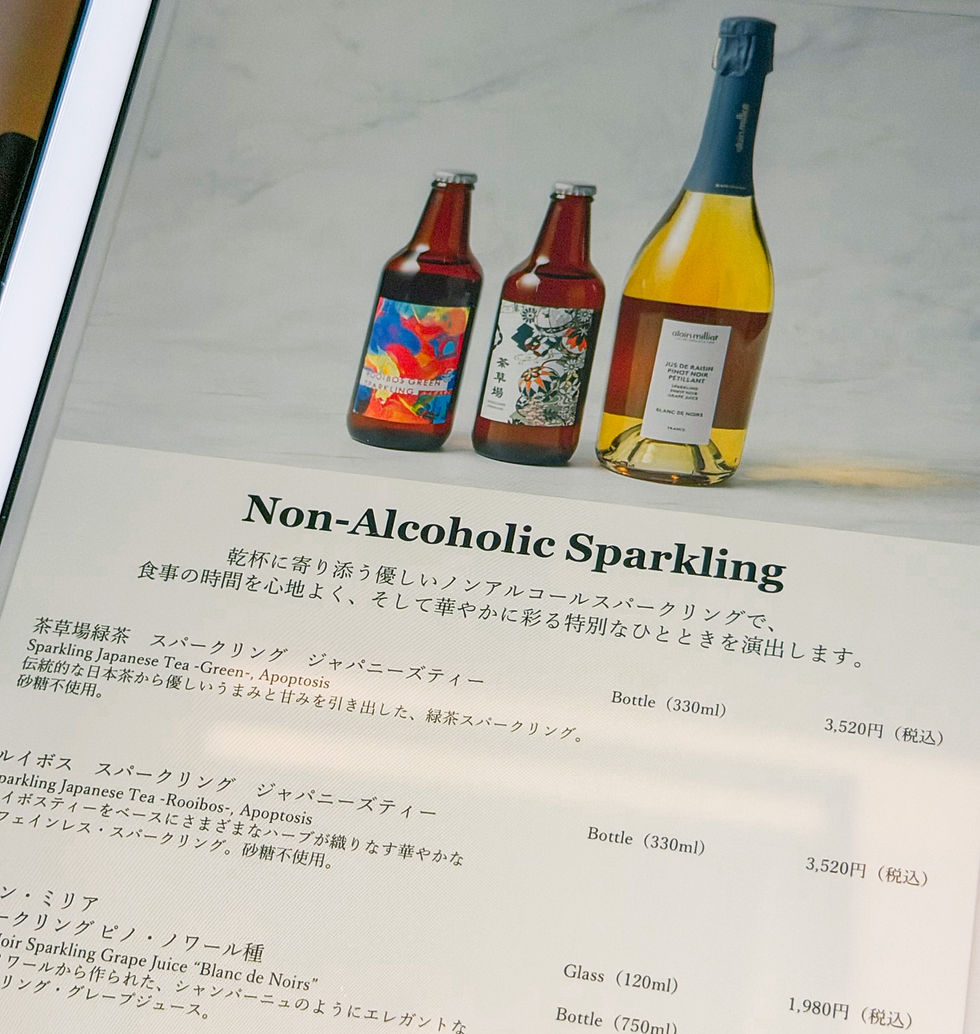
The menu designed by Mr. To features Apoptosis sparkling tea as a recommended choice for the initial toast. As you scroll down, you’ll find recommendations for drinks to enjoy with meals, options for special occasions, and selections the whole family can enjoy—creating a structure that encourages customers to take their time and carefully choose the perfect drink for any occasion. They report that improving the menu has led to a higher average customer spend compared to other establishments.
When it comes to non-alcoholic beverages, the concept of “choosing your favorite from a variety of options” or “deciding how to vary your drinks—first, second, and third glasses” has yet to take hold. That’s precisely why presentation is just as important as taste. Customer choices are influenced by how the drinks look—down to the very appearance of the beverage itself.
Domestically produced beverages embody the hotel’s concept and contribute to the unique value of this region.
What Mr. To prioritizes is not simply providing high-quality service as a hotel. Rather, it is how The Kahala Hotel & Resort Yokohama can convey the value of the local community through its dining experiences. This aligns perfectly with KISCA’s philosophy.
KISCA stands for “The Kahala’s Initiative for Sustainability, Culture, and the Arts.” Launched in 2017 at The Kahala in Hawaii, this initiative is dedicated to passing on Hawaii’s beautiful nature and culture to younger generations and future generations. In Yokohama, rather than simply importing this spirit as-is, the team is exploring how to establish it as a “Yokohama-style KISCA.”

In this context, “local respect” is key. Mr. To is actively incorporating domestic beverages, including Japanese wine, in an effort to convey the flavors of Japanese ingredients and unique Japanese tastes to both domestic and international guests.
In fact, the selection of Japanese wines has expanded significantly. This approach to food and beverage design resonates with KISCA’s philosophy of connecting the hotel’s value to the local community while respecting the land, culture, and people’s way of life.
“Many people associate The Kahala Hotel & Resort with Hawaii, but when I think about what the KISCA spirit means for us here in Japan, I believe it comes down to ‘Local Respect.’”
Executive Chef Aoki is also from Kanagawa and frequently incorporates local ingredients from the region into his dishes. Furthermore, Mr. To touched on the kind of experience he hopes to provide through “Local Respect.”
“Among the guests who visit our hotel, there are many business owners and others who are fighting a lonely battle. We must always provide them with the vitality they need to recharge. What kind of service will truly resonate with them? Our affluent guests have experienced a wide variety of things, so we must offer something truly special.”
Apoptosis is another element introduced within that context.
Taste Isn’t the Only Reason for Choosing Apoptosis—Photo Sales and Demand for Decaf
Mr. To’s customer-centric approach is also evident in the story behind the introduction of Apoptosis products. When he offered Shine Muscat juice—originally priced at 30,000 yen—as a trial, the response exceeded expectations. While Kyoho grape juice is relatively common, Shine Muscat juice is rarely seen on store shelves, making it the perfect choice for creating a sense of exclusivity.
After seeing the positive response to non-alcoholic beverages through this experience, he began searching extensively for the next product to launch, with the help of members of the purchasing department. That’s when the Apoptosis label caught his eye.
“The label really shone. I pictured taking a photo of it and putting it on the menu, and I thought, ‘This is going to sell.’”
In addition, the presence of rooibos sparkling tea played a significant role.

Mr. To had been looking for decaffeinated products for some time. At luxury hotels, there are many reasons why guests might choose not to drink—such as guests from North America, pregnant guests, guests who want to avoid caffeine during dinner, and guests who used to drink alcohol but are now cutting back. In such situations, it’s important to offer more than just soft drinks—it’s crucial to have a beverage that can be recommended based on each guest’s specific circumstances.
“We’d been looking for decaffeinated options for a long time, so we ordered plenty of samples, consulted with our staff, and narrowed it down to these two. We were absolutely set on using the rooibos sparkling tea. As for the green tea sparkling drink, the carbonation complements the fresh, bamboo-like flavor, adding an extra sense of refreshment. We also recommend it to guests who prefer something unsweetened.”
In practice, they serve these two beverages in wine glasses. This is done to enhance the aroma and, at the same time, to establish them as “drinks worthy of a toast.” The way this is naturally presented on the menu as a suggestion for the initial toast could serve as a useful reference for other food and beverage establishments.
Non-Alcoholic Drinks Can “Fit Right In” — The Value of Reproducible Pairings and an Uninterrupted Experience
Mr. To sees the appeal of non-alcoholic drinks as “the ability to tailor them to complement the food.” Unlike wine, they are relatively less influenced by variations in vintage or individual batches, and—much like mocktails—they can be blended to intentionally match the food.
“I think non-alcoholic drinks actually have greater potential for pairing. Just like wine, you pair them with food based on aroma, flavor, and texture.”
For example, sparkling green tea—with its fresh, green notes, refreshing quality, and crisp effervescence—pairs well with dishes that highlight the natural flavors of ingredients, soups, and dishes featuring acidity. Rooibos sparkling, on the other hand, features a complex aroma reminiscent of herbs and fruits, along with the functional benefit of being caffeine-free, making it a natural choice for toasts, light appetizers, and finger foods. For both, the fact that they are “not sweet” enhances their versatility as pairing options.

More importantly, non-alcoholic drinks do not disrupt the dining experience. It is not unusual for people who drink and those who don’t to dine together.
In fact, Mr. Tō cited an example of a family of four—including children—who visited the restaurant and enjoyed a non-alcoholic pairing together. He explained that the great value of non-alcoholic options lies in the fact that everyone—regardless of whether they drink alcohol—can savor the food and drinks in the same sequence. Whether it’s a business dinner or a family outing, a scenario where only one person has to make do with water or tea is not satisfying for a luxurious dining experience. Non-alcoholic pairings have the power to bridge that gap.
“With non-alcoholic options, the whole family can share the same experience, right?”
Eating out is a “treat”—which is exactly why you shouldn’t end the meal with just water
Mr. Tō believes that “treat-driven demand” will become increasingly prominent in the dining-out industry going forward.
In this era of high prices, restaurants will shift from being places people visit frequently as part of their daily routine to places they visit for specific occasions—such as birthdays, anniversaries, family dinners, or reunions with old friends. What customers will seek on such occasions isn’t simply whether a drink is alcoholic or non-alcoholic, but rather a special drink that feels fitting for the moment.
“I think that in the coming era, dining out will become a treat for office workers.”
It is necessary to offer proposals that encompass the joy of choosing, the value of having something to talk about, and even the lingering aftertaste that harmonizes with the food.
Non-alcoholic drinks are no longer merely substitutes for alcohol. Their value lies in the reproducibility of precise pairings—where the drink is meticulously matched to the food—and in the fact that both drinkers and non-drinkers can enjoy the dining experience together in the same way. Perhaps these qualities are beginning to be appreciated anew.
[Key Points of The Kahala Hotel & Resort Yokohama / Yokohama Bay Court Club]
① They plan their product selection by working backward from the “sales approach”
They don’t just select high-quality products; they design the entire experience—including which serving vessels to use, the order of presentation, and the customer flow. The integration of a sommelier’s discerning eye with a marketing perspective is Mr. Tō’s most distinctive feature.
② They commercialize non-alcoholic beverages by focusing on “presentation”
They design the sales floor with attention to detail—from labels and photos to menu consistency and how the products appear on tablets. This is a practical example demonstrating that for non-alcoholic beverages, the entry point that attracts customers is just as important as the taste.
③ Viewing non-alcoholic beverages as a bridge between drinkers and non-drinkers
They find value in the fact that drinkers and non-drinkers can share the same sense of excitement at the same table. They clearly define the role of non-alcoholic beverages for different occasions, such as toasts, food pairings, business entertaining, and family gatherings.
[Apoptosis Products Currently in Use at The Kahala Hotel & Resort Yokohama / Yokohama Bay Court Club]

Sparkling Japanese Tea -Apoptosis Green-

A sparkling tea made from tea leaves cultivated using the Chasoba farming method, a Globally Important Agricultural Heritage System (GIAHS). It is characterized by a refreshing aroma reminiscent of wild grasses and wildflowers, a gentle umami and natural sweetness from the tea leaves, and a clean finish followed by a pleasant astringency and richness. It pairs well with dishes that highlight the natural flavors of the ingredients, dishes with a tangy flavor, and soups and dishes with thick sauces.
Sparkling Japanese Tea -Rooibos-
A non-sweet, sparkling tea for adults, featuring a rooibos base layered with the aromas of herbs, blueberries, cranberries, aloe, and yogurt. Caffeine-free, it’s easy to recommend and pairs well with toasts, standing receptions, finger foods, and light appetizers. It’s the perfect drink for luxurious dining occasions, offering a compelling reason to skip alcohol.
If you’d like to learn about the latest trends in non-alcoholic beverages or try some of our recommended drinks, please contact us.
Apoptosis develops, curates, and provides a wide variety of non-alcoholic beverages for hotels and restaurants. Feel free to contact us via the “Contact” page.
Location Information:
The Kahala Hotel & Resort Yokohama
1-1-3 Minatomirai, Nishi-ku, Yokohama, Kanagawa 220-0012
Yokohama Baycourt Club Hotel & Spa Resort
1-1-4 Minatomirai, Nishi-ku, Yokohama, Kanagawa 220-0012
Interview Cooperation: Mr. Yoshiyuki To (Wine & Spirits Manager, The Kahala Hotel & Resort Yokohama)
Interview Date: May 2026


